
Large eddy simulation
Depending on the problem specification, a given grid resolution may not be sufficient to resolve all spatial features of the flow. Consider the following example:
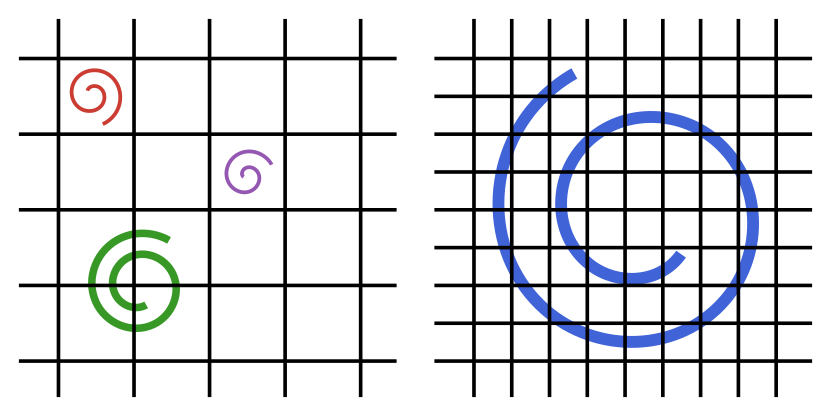
On the left, the grid spacing is too large to capture the smallest eddies in the flow. These eddies create sub-grid stresses that also affect the large scale features. The grid must be refined if we want to compute these stresses exactly.
On the right, the smallest spatial feature of the flow is fully resolved, and there are no sub-grid stresses. The equations can be solved without worrying about errors from unresolved features. This is known as Direct Numerical Simulation (DNS).
If refining the grid is too costly, a closure model can be used to predict the sub-grid stresses. The models only give an estimate for these stresses, and may need to be calibrated to the given problem. When used correctly, they can predict the evolution of the large fluid motions without computing the sub-grid motions themselves. This is known as Large Eddy Simulation (LES).
Eddy viscosity models
Eddy viscosity models add a local contribution to the global baseline viscosity. The baseline viscosity models transfer of energy from resolved to atomic scales. The new turbulent viscosity on the other hand, models energy transfer from resolved to unresolved scales. This non-constant field is computed from the local velocity field.
The following eddy viscosity models are implemented (see Silvis et al. [9] for an overview and analysis):
Smagorinsky[10] (2D and 3D)WALE(wall-adapting local eddy-viscosity) [11] (3D)Vreman[12] (3D)QR[13] (3D)
The models are used by including them in the right-hand side function passed to solve_unsteady, with the model coefficient in params; see examples/ChannelFlow.jl for a complete simulation with an eddy viscosity model. Neural closure models trained on the discrete equations of this package are explored in Agdestein and Sanderse [1].
API
IncompressibleNavierStokes.collocate_tensor Function
Collocate staggered tensor to the center of the cell. Put the tensor in a statically sized SMatrix.
IncompressibleNavierStokes.eddy_viscosity_closure! Method
eddy_viscosity_closure!(eddyvisc, f, u, cache, setup)Apply eddy viscosity closure model.
sourceIncompressibleNavierStokes.smagorinsky_closure! Method
smagorinsky_closure!(f, u, θ, cache, setup)Apply Smagorinsky closure model.
sourceIncompressibleNavierStokes.symmetrize! Method
symmetrize!(G)Compute symmetric part of tensor. Overwrite the upper diagonal of the tensor itself. The lower diagonal is not modified - don't use it!
source